Thursday, 16 October 2014

October Inspiration

Our September was sunny and warm: a real Indian summer but with October, autumn has arrived and the sunset time of the year.


In the midst of what is undoubtedly a busy season, I was challenged by this article from Jess Connell, Are you a "Mommy Martyr"?  Thank you to Kondwani of Home Education Novice for pointing out this blog.

It is easy to feel that learning always has to be fun. Often it is and should be but somethings just have to be learned. Learning about the discipline of work is one of those things. This article at Lextin Academy points out why homeschooling doesn't have to be fun all the time.

Claire, at Angelicscalliwags has been outlining her plans for the school year. The posts are well worth reading for ideas. Having a busy five year old, I was particularly interested in her plans for her five year old.

Sometime ago I reviewed Simonetta Carr's book on Lady Jane Grey from the Christian Biographies for Young Readers series. Ossett Christian Bookshop currently  has a special offer on this series and is selling the books at £9.99 while stocks last.


If you enjoyed this post you may like to follow Delivering Grace by Google Friend Connect, G+,FacebookPinterest or e-mail.


Tuesday, 14 October 2014

Bringing history to life

A couple of years ago, we spent a muddy Saturday watching the 1066 reenactment. The site was so muddy that only one of the six who went failed to fall over. No, I wasn't the one standing. Despite this and the fact that the Saxons and Normans have nothing to do with our current history, there were pleas to go again. Delight-directed learning-can't turn this down! So we went to the annual reenactment of the Battle of Hastings which is held by English Heritage on the weekend closest to the date of the Battle (14th October 1066- 948 years ago today!)

The mud was not so deep and we were better prepared so this year, the score was only one fall out of seven.

The Saxons preparing to fight.

The Norman cavalry. The Saxons didn't use horses.

Norman arrows

The Norman archers

Ultimately, the Saxons lost as their line of shields broke rank when the Normans feigned retreat.
The last stand of the Saxon standard-the white man on a red background.

The Abbey said to have been built by William the Conqueror as penance for the blood shed. It is said that the altar was over the spot where Harold was killed. 

Interestingly, there is some suggestion that this place, Senlac Hill in Battle, isn't the actual site of the Battle. Still, reenactments are a fascinating way of understanding a little more about what happened. There was strong support for the Saxons so we would have had to disappear rapidly if this had been the actual battle.

If you enjoyed this post you may like to follow Delivering Grace by Google Friend Connect, G+,FacebookPinterest or e-mail.

Friday, 10 October 2014

Teaching younger children about the First World War

In this centenary year, it seems important for children to know a bit about the First World War. I had some concerns about this as wars are unpleasant and I didn't want to traumatise my children. These are some resources that I have used, or plan to use, with my younger two, aged 5 and 7, and some comments on these. There are plenty of other information sources about the First World War: many of these are not suitable for younger children. I also realise that opinions on what is and isn't suitable vary so do check for yourself. I have usually allowed talk about numbers of deaths and injuries but not graphic details.

Family resources
  • Family memories. My husband and I are fairly "elderly" parents to our two younger children and my husband's parents were in their mid-thirties when he was born. This means that one of the children's grandmothers was born within a few years of the First World War. Her father fought in the War and she can tell family stories from that time. Of course, many children of early primary age will have much younger grandparents but there may be great-grandparents who have First World War stories to tell.
  • Family diaries. We have two very different diaries from different sides of the family which cover the First World War. One is of a nurse who looked after the War wounded and the other of a man who had sons at the Front. I have been reading one of these to the children. They have been interested in comments about early cars and tractors as well as about the War.
  • Family photos. 
Local resources
  • There are war memorials in almost every parish in the country. 
Books
These aren't formal textbooks. 
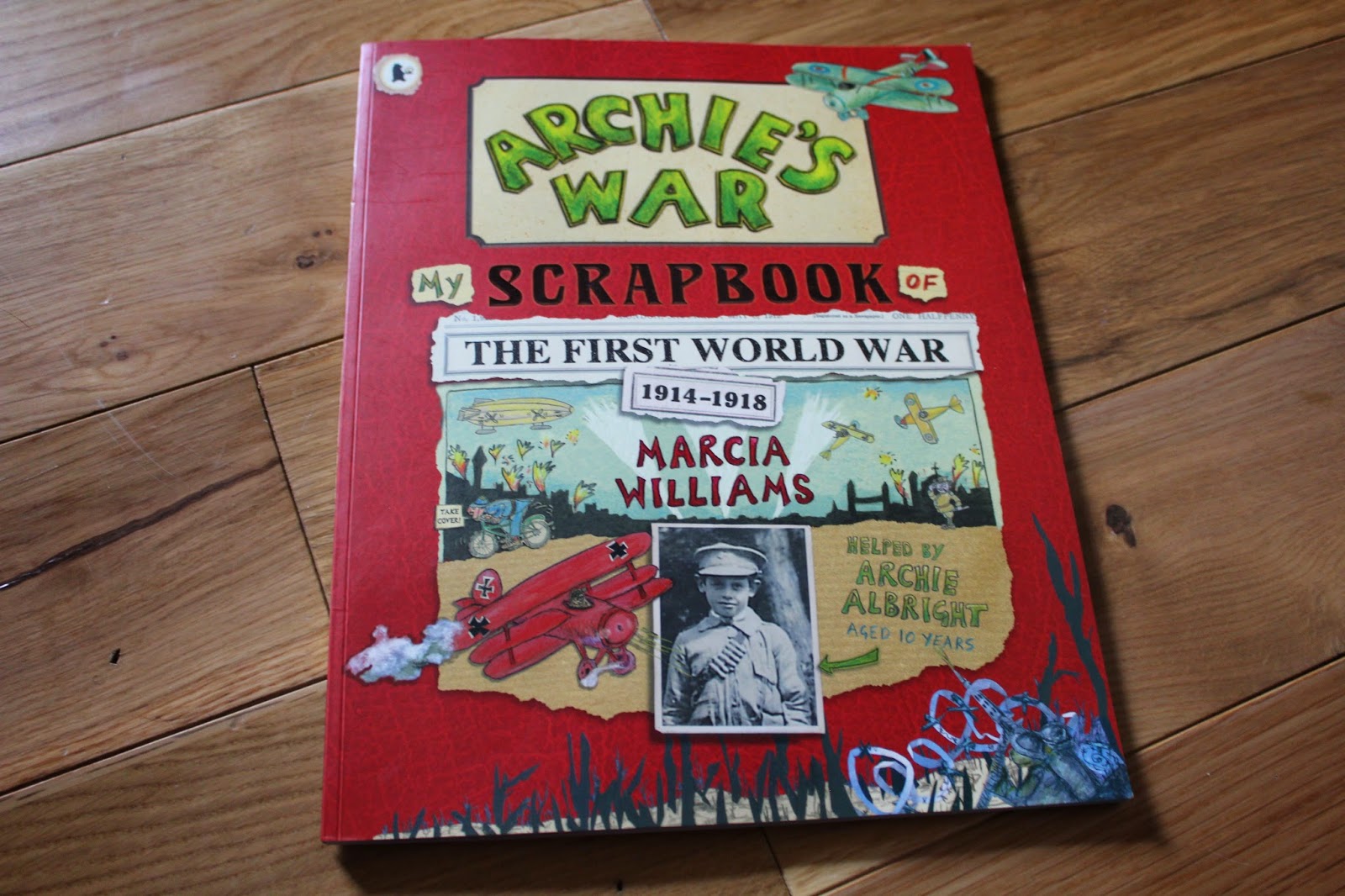
  • Archie's War Scrapbook 
  • The Usborne World War I sticker books were a popular introduction here. There are two: Sticker Dressing: First World War and First World War sticker book.
  • Mailing May by Michael O Tunnell. This picture book is set in the US in early 1914 before the start of the War and well before the US entered. However, it does set the scene of the times for younger children even if most children weren't sent on the train as a parcel. This is based on a true story.
  • Fly, Cher Ami, Fly by Robert MacKenzie is based on a true story about a carrier pigeon who saved a lost battalion.
  • Where the poppies grow by Hilary Robinson and Martin Impey is again suitable for younger children.
    My five year old loved this book which is written to the same rhyme as This is the house Jack built. The story line covers two friends who grow up together and then go to fight together. During the battle, one saves the life of the other. There is plenty to discuss from this book but it is presented in a gentle way. This would probably be the book that I would choose to use with little ones.
  • War Game by Michael Foreman is another picture book but do read before sharing with sensitive children.
  • The book is dedicated to the four dead uncles of the author who died in the First World War and who also share the same names as the young men in the book. The book covers the trenches and the 1914 Christmas Day truce but also ends with the death of one of the young soldiers. A beautiful and thought provoking book.


  •  Letters to Henrietta by Nell Marshall is a book of family letters along with detail about the War. Probably a book to dip into with younger children.
  • War Horse by Michael Morpurgo is a famous chapter book about Joey, a horse who went to war. I preread this before letting my daughter listen to an audio version. Please note that some of the horse's carers and riders die but Joey himself survives. I had thought that I would take my daughter to the play of this book but this is for 10+ only. I am told that with the sound effects this is much more dramatic.

  • Poetry
    There is, of course, a plethora of First World War poetry. 
    Particularly suitable for this age group are
    Websites
    Please note that I do not endorse other material on these websites.


    • BBC Schools Primary resources has a section on the First World War.  This includes detail about everyday life for a child, at the time.
    • The Bible Society has interesting pages about Christians during the War.
    • World War One Photos has photos, poetry and recordings for songs. Please preview before using with young children. 
    Other
    The Royal British Legion produces an educational pack with DVDs including one with First World War clips. This is free to home educators. Please note that some of the other DVDs are marked as not suitable for young children. The First World War section should also be previewed. We found the DVD clip of the Battle of the Somme was quite disturbing.

    Updated 23rd October 2014.

    Please do let me know about other resources that you have used to explain the First World War to younger children.

    If you enjoyed this post you may like to follow Delivering Grace by Google Friend Connect, G+,FacebookPinterest or e-mail.

    Wednesday, 8 October 2014

    The Great History of Britain

    It isn't easy to find a history book for younger children which looks at history chronologically so I was delighted to be able to review The Great History of Britain by Anne and Paul Fryer.

    As a home educator, I'm not constrained by the National Curriculum. It had always seemed sensible to approach history chronologically and we, like many other home educators, had tried to do this. I was pleased to note that in the latest version of the National Curriculum, the Government has also come over to this approach!

    Anyway, we've used various books but a real lack has been an up to date  history of Britain for younger children. Anne and Paul Fryer have plugged this gap with their 371 page book. The book starts in Roman times and each chapter edges forward; ending with Modern Britain including a discussion of the European Union and the Channel Tunnel. Each page is illustrated with a relevant black and white drawing and the font is large making the book accessible to children. In terms of age, the book is aimed at primary ages. I read it aloud to my five and seven year olds. The five year old listened to parts but my seven year old loved this book and began to request it for her bedtime story.

    The sections are short enough to be read to quite young children but its clear, uncondescending presentation makes the book suitable for a quick read for adults or teenagers who want an overview of the chronology of British history.

    Many history books for children seem to be written from a secular humanist point of view and contain statements implying that religion is something that was only relevant to earlier times. This book doesn't do this, for example, in its coverage of the Armada, it states

    Queen Elizabeth was delighted at the failure of the Armada. She had a special medal created which had an inscription on it which said "God blew and they were scattered".

    This book does not have an overtly religious stance but comes across as respectful to Christians and the issues and concerns which been important to Christians in the history of Britain.


    The Great History of Britain is going to be something that we refer to again and again.I would highly recommend this for all families with children of primary age whether they home educate or not. I liked the book enough that I have ordered another copy to give as a  gift for an upcoming occasion.

    The Great History of Britain is available on Amazon priced at £8.86 as a soft cover and £4.15 as a Kindle download.

    A trailer for the book is available.

    I understand that it is hoped to produce an accompanying activity book. 


    I was provided with a copy of The Great History of Britain for the purpose of this review. I was not obliged to give a positive review. The views expressed are mine and those of my children.

    If you enjoyed this post you may like to follow Delivering Grace by Google Friend Connect, G+,FacebookPinterest or e-mail.


    Saturday, 4 October 2014

    Sufficient Grace

    Sorry to have been missing in action most of the week. Some weeks are just more busy and challenging than others. This week has been one of the more challenging variety: illness and health issues for various family members; working out how to home educate around two hospital appointments in one day; Eldest Son going back to university plus the usual struggling and failing to keep up with housework and gardening. The feeling of never doing enough yet always being busy. 

    In such a week, I have to go back to one of my favourite Bible verses where the Lord says to Paul

    My grace is sufficient for thee: for my strength is made perfect in weakness. 
    2 Corinthians 12 verse 9

    This week, I have been teaching the children this hymn which fits with just this verse.

     How firm a foundation, ye saints of the Lord,
    Is laid for your faith in God's excellent Word!
    What more can be said than to you God hath said,
    To you who for refuge to Jesus have fled?
     "Fear not, I am with thee, O be not dismayed,
    For I am thy God, and will still give thee aid;
    I'll strengthen thee, help thee, and cause thee to stand,
    Upheld by my righteous, omnipotent hand.
     "When through the deep waters I call thee to go,
    The rivers of sorrow shall not overflow;
    For I will be near thee, thy troubles to bless,
    And sanctify to thee thy deepest distress.
     "When through fiery trials thy pathway shall lie,
    My grace, all sufficient, shall be thy supply;
    The flame shall not hurt thee; I only design
    Thy dross to consume, and thy gold to refine.
     "The soul that on Jesus hath leaned for repose,
    I will not, I will not desert to its foes;
    That soul, though all hell should endeavor to shake,
    I'll never, no, never, no, never forsake."
    From Rippon's selection

    On the way back from the university trip

    Tuesday, 30 September 2014

    Preschoolers and Peace-review

    I remember starting home education with an eight year old, two year old and baby. My initial idea was to give my two year old nursery workbooks but discovered within a day that whilst she loved scribbling over the pages, she "finished" them in a few minutes. It rapidly became obvious that another approach would be better! By the time that the then baby became a toddler, needing to keep him occupied became one of my most major challenges.

    Preschoolers and Peace often don't seem synonymous and probably one of the greatest challenges to home education is having younger children wanting to join in and have attention. Not infrequently, home education lists have questions about whether to send the little ones to nursery so there can be some peace. Kendra Fletcher, of  Preschoolers and Peace,
    Preschoolers and Peace Review
    has written an e-book, for home educators, Preschoolers and Peace: Homeschooling older kids with success while loving the little ones at your feet, from her experience of home educating her eight children. 


    oPreschoolers and Peace Review
    This is a practical book. The chapter list gives an indication
    • What a Homeschooling Mom needs
    • Preparing yourself to Homeschool Older Kids with Little Ones Underfoot
    • Planning around Preschoolers
    • How do I keep them busy?
    • What does a 2 year old's day look like?
    • How do I get any Preschooling done?
    • How not to just kill the time.
    • Circle Time, or How We Pull the Little Ones in.
    • Preschool Boys
    • When all your Kiddos are Preschoolers
    • Preschool Chores
    • Planning for Preschool
    • When Mama is Worn Out (or Pregnant)
    • Meal Planning 101
    • A final word of Encouragment.
    The book is by a Christian mother and she reminds us to show the Good News of God's grace to the little ones and to start the day with prayer. She goes on to some ideas about ordering their day, suggesting a routine rather than a rigid timetable.

     I know that when my children were younger, the How do I keep them busy chapter would have been particularly helpful. Kendra provides ideas for occupying the little ones. Yes, there are plenty of ideas around but there are ideas which generally would work while older children are working. So for example, there is a list of high chair activities as well as other suggestions. Playing at the kitchen sink is certainly something that I allowed/encouraged while the other children worked at the kitchen table. 

    The chapter about a two year old's day gives specifics of room time where the toddler learns to play alone.

    The chapter on Circle Time explains how little ones can be included in the day and preschool chores has a list of possible chores by age. The end of the book has ideas for meal planning and some links, many of which are to the Preschoolers and Peace blog.

    What did I think?
    Preschoolers and Peace is a must for anyone home educating with little ones around. It is both practical and encouraging. Just knowing that someone else has home educated successfully with little ones in tow, is uplifting. The activity ideas were particularly helpful as were the ideas for including little ones in chores.


    My only caveats are that some of us have preschoolers who don't nap. None of mine napped after the age of about two. Indeed, naps in the day were discouraged as they lead to very awake children in the evening. I don't think this is an uncommon problem. My other thought is that some of the activities suggested are more suitable for the older preschooler than a mad two year old. Use your common sense!

    Overall, though, this is a must have book for anyone home educating older children with preschoolers around.

    Cost
    Preschoolers and Peace is an ebook and is available for $2.99 in the US and £1.85 in the UK. The link to purchase is on the Preschoolers and Peace page.

    For more reviews, visit the Schoolhouse Crew blog.


    Crew Disclaimer

    Friday, 26 September 2014

    Reading Aloud: 11 Practical Thoughts

    This is a mini-series about reading aloud. I'm no expert just a parent who has spent an enormous amount of time reading to her children, over the years.

     I posted about Five Benefits of Reading Aloud and one thing that it hasn't achieved for us.


    Now some practical points.


    • Start young, really young. We have read aloud to the children from before they could crawl. I wrote about the benefit of this in the previous post.

    • When reading to several children, we start with books for the youngest. They may then listen to the older children's books or they may not but at least they have enjoyed some books. 

    • I've never found that reading completely above the child's head helps anyone. The child doesn't understand and it is rather tedious reading aloud to oneself. 

    • Give wriggly, younger children something to do while reading chapter books. We have one child who loves to colour but another who would much prefer to be making a Lego or Meccano model.

    • Have a drink to hand!

    • Sit somewhere comfortable. We usually read on the sofa but have read in bed, in the garden, in a tent, in a den, at a picnic, on the train and probably more places. I don't read in the car. We have audio books for the car.

    • If the children don't like the book, change books.

    • If you don't like the book, stop reading. There are plenty of other books out there!

    • There are many occasions in a day for reading. I tend to read aloud at breakfast, in the early afternoon and at bedtime. My husband reads the Bible aloud at a mealtime and then reads to the younger children at bedtime. Yes, they often have books from both parents at bedtime.

    • We tend to stop reading aloud, except the Bible, when the child is a very competent reader. By this, I mean, able to read classics competently on their own, although I know many families carry on with read alouds beyond this stage. 

    • We read a mixture of books. Current read alouds are Leading Little Ones to God, Caddie Woodlawn, The wanderings of Odysseus, Monasteries (a history book by Unstead for my history lover), Jungle Doctor pulls a leg plus picture books.
    What do you do to ensure your read aloud time goes well? It is always fun to know what other families are reading. Please share!


    Hip Homeschool Moms


    If you enjoyed this post you may like to follow Delivering Grace by Google Friend Connect, G+,FacebookPinterest or e-mail.